The verdict
$399How we tested the Theragun Pro
We used the Theragun Pro daily for two months after workouts and desk days — testing depth, stall force, the rotating arm, noise, and the swappable-battery workflow.
- Used it daily for two months on quads, back and shoulders
- Leaned in hard to test the 60 lb stall force and 16mm depth
- Used the rotating arm to reach our own back
- Judged noise versus older models and the dual-battery workflow
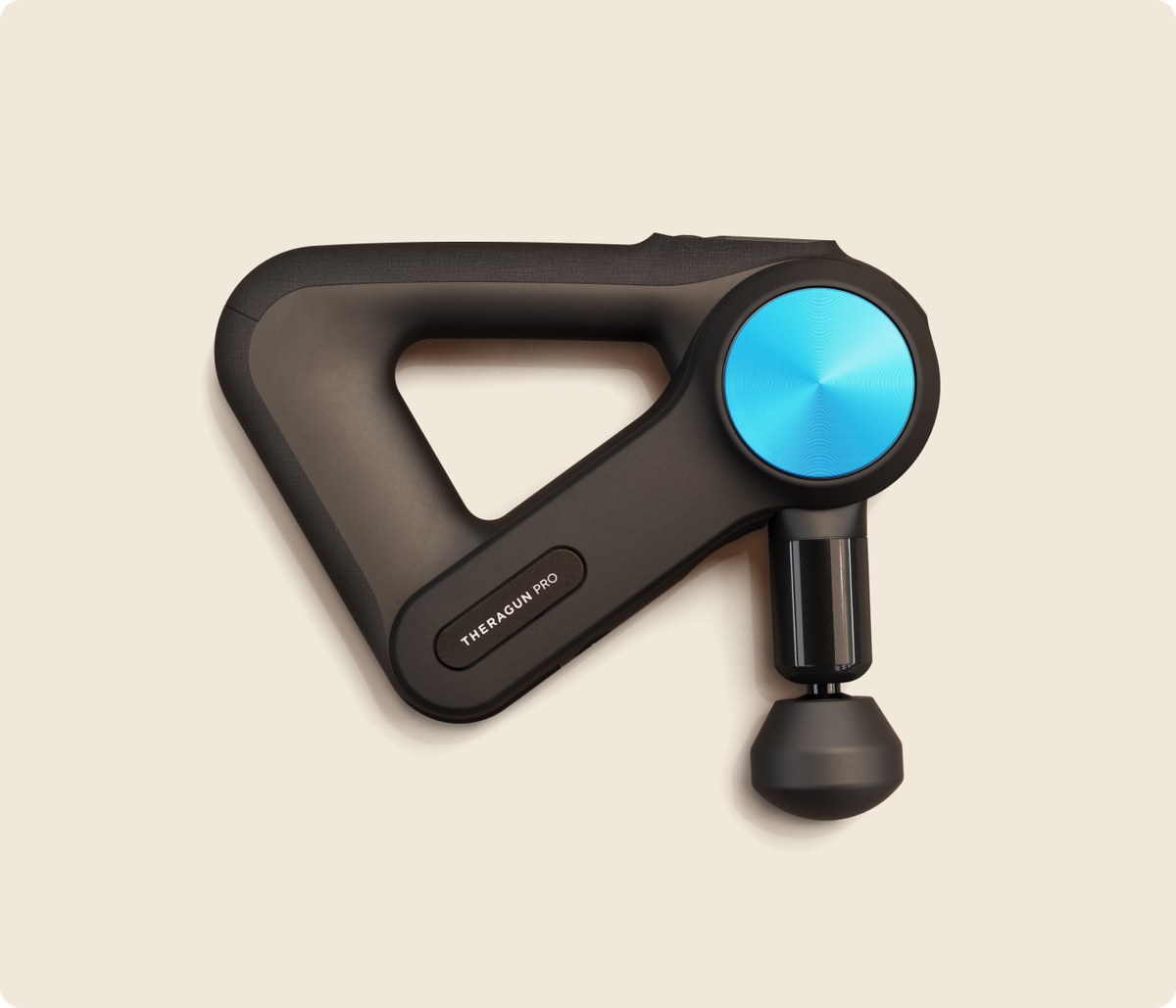
Most massage guns bounce off tight muscle; the Theragun Pro drives into it. Its 16mm amplitude reaches deeper than almost anything else, and 60 pounds of stall force means it does not bog down when you lean in. A rotating, adjustable arm lets you reach your own back and shoulders, two swappable batteries keep it running, and QuietForce tech keeps it far quieter than the old Theraguns. For serious recovery, it is the tool the pros actually use.
| Type | Professional percussion massage gun |
| Amplitude | 16 mm deep reach |
| Force | Up to 60 lb, no-stall |
| Speeds | 5 (1,750–2,400 PPM), plus app control |
| Arm | Rotating, adjustable 4-position |
| Battery | 2 swappable, ~150 min each, USB-C |
| Screen | OLED with force meter |
| App | Bluetooth, guided routines |
| Attachments | 6, plus QuietForce noise reduction |
What the Theragun Pro is
The Theragun Pro is Therabody’s professional-grade percussion massage gun — the model physical therapists and athletes reach for. Percussion therapy works by pounding muscle rapidly to increase blood flow and release tension, and the Pro does it harder and deeper than most: a 16-millimetre amplitude (how far the head travels) and up to 60 pounds of force before it stalls. A rotating arm, an OLED screen and app control round out a tool built for daily, serious use.
Design and build quality
The Pro’s signature is its ergonomic triangular multi-grip handle, which lets you hold it several ways to hit different muscles without straining your wrist — the feature that makes long sessions comfortable. The rotating arm adjusts to four positions so you can reach your own mid-back and shoulders, which single-angle guns cannot. It is solidly built and heavier than a mini gun, but that heft is part of what lets it deliver force without bouncing off.
Setup, controls and the app
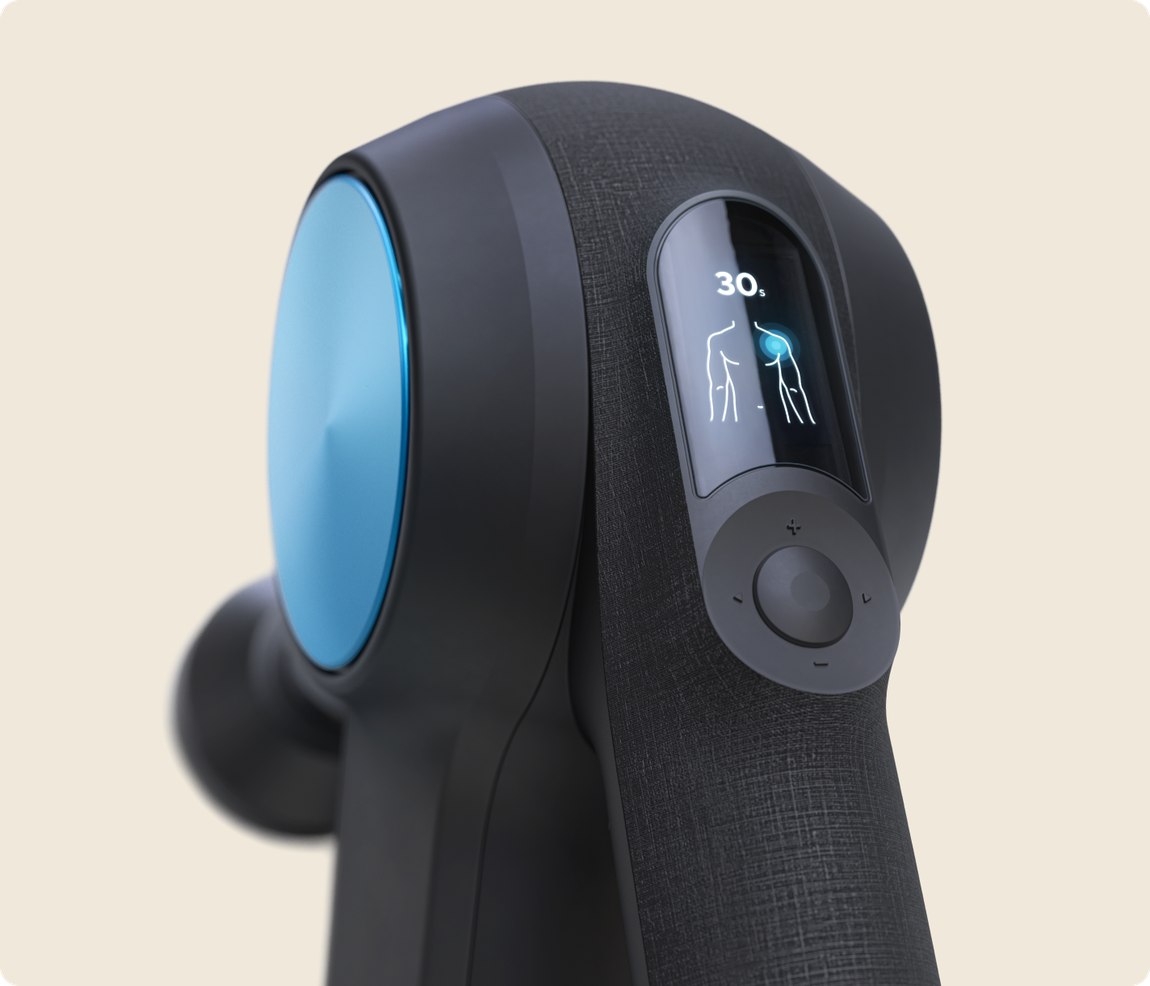
There is no setup beyond charging: click on an attachment, press the trigger, and go. An OLED screen shows speed and a real-time force meter that tells you how hard you are pressing — genuinely useful for staying in an effective range. Bluetooth connects to the Therabody app, which offers guided routines and can control speed automatically. The app is a nice extra rather than a necessity; the gun works fully on its own.
Percussion performance
This is where the Pro separates itself. In our testing the 16mm amplitude reached deep into large muscle groups — quads, glutes, back — in a way shorter-stroke guns cannot, and the high stall force meant it kept pounding when we leaned in hard, where cheaper guns simply stop. The five speeds (1,750–2,400 percussions per minute) cover gentle warm-up to deep work. For real muscle tightness and post-workout recovery, the depth and force are the whole reason to buy it.
Attachments and use cases
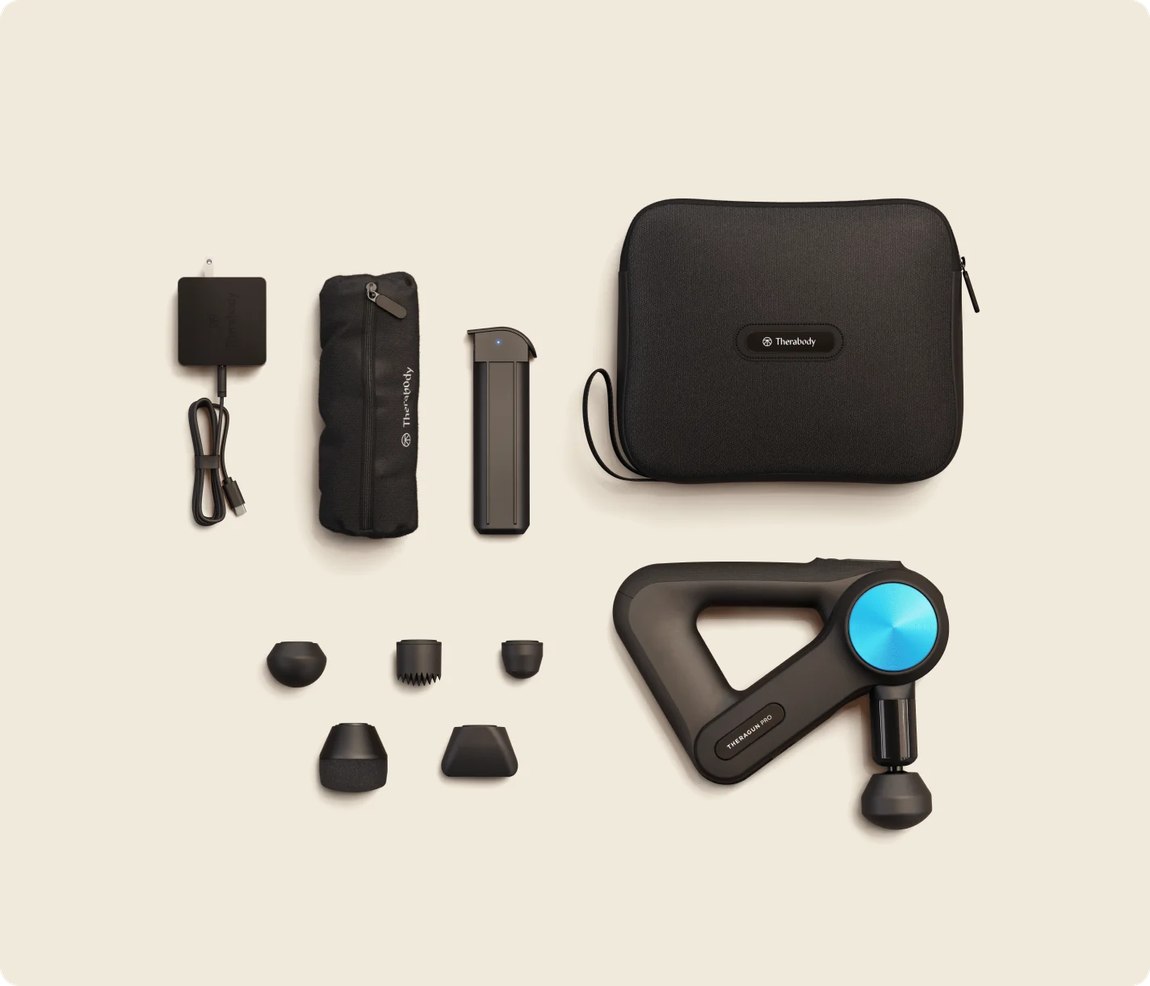
The Pro ships with six attachments for different needs: a dampener for sensitive or bony areas, a standard ball for large muscles, a thumb for lower-back and trigger points, a cone for pinpoint work, a wedge for shoulder blades and IT bands, and more. Between the attachments and the rotating arm, it covers the whole body, including the hard-to-reach spots. For athletes, physios and anyone with chronic tightness, that versatility is a large part of the value.
Noise
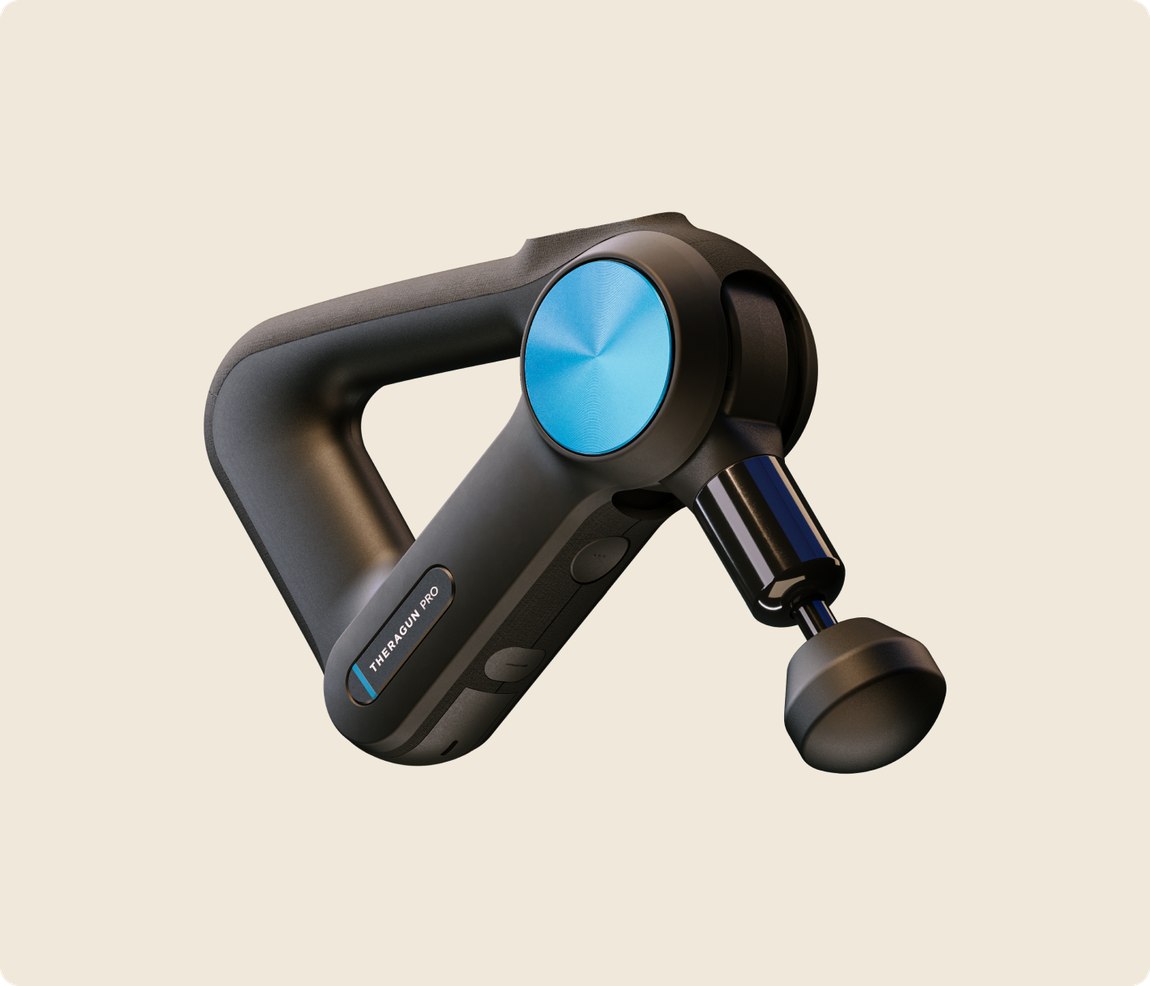
Early Theraguns were loud enough to annoy a room; the Pro’s QuietForce technology fixes most of that. In our testing it was noticeably quieter than older models — a low, muffled thud rather than a rattle — quiet enough to use while watching TV. It is not silent, and a deep-percussion gun never will be, but the noise is no longer a reason to avoid it. For most homes it is perfectly livable.
Battery and everyday use
The two swappable batteries are a practical advantage: each lasts around 150 minutes, so you charge one while using the other and effectively never run out — useful for a clinic or a household of users. USB-C charging is convenient. Day to day, the Pro is the gun you reach for after a workout or at the end of a desk-bound day; the multi-grip and rotating arm make self-treatment genuinely easy, which is what keeps people actually using it.
How it compares to the alternatives
Against Hyperice’s Hypervolt, the Theragun Pro hits deeper (16mm vs ~14mm) with more stall force and adds the rotating arm and swappable batteries, where the Hypervolt is a touch quieter and simpler. Against Therabody’s own cheaper models (Prime, Relief, Mini), the Pro adds amplitude, force, the rotating arm and dual batteries — the step up for serious users. Against the pricier Pro Plus, it drops the heat, LED and vibration multi-therapy but keeps the core percussion power for less.
Price, value and warranty
At around $399 the Pro is a premium massage gun, and the value depends on how hard you use it. For an athlete, a physically demanding job, or chronic tightness, the depth, force, rotating arm and dual batteries justify the price over cheaper guns that stall and cannot reach your back. For occasional light use, a cheaper Therabody Mini or Prime is enough. Therabody backs it with a warranty and a strong service reputation.
Who it is for, and who should skip it
Buy it if you train hard, work physically, or carry chronic muscle tension and want the deepest, most powerful percussion with a rotating arm and all-day batteries. Skip it if you want light, occasional relief — a smaller, cheaper gun does that — or if you specifically want the heat and LED multi-therapy of the Pro Plus. For serious deep-tissue recovery at home, the Theragun Pro is the benchmark.
Pros & cons
What we like
- 16mm amplitude reaches deep where cheaper guns bounce off
- 60 lb of stall force — keeps pounding when you lean in
- Rotating arm reaches your own back and shoulders
- Two swappable batteries mean it never runs out
- Much quieter than older Theraguns thanks to QuietForce
Worth knowing
- Premium price versus basic massage guns
- Heavier than a mini or travel gun
- Not silent — deep percussion never is
- Overkill for light, occasional use
Where to buy the Theragun Pro
Check the current price and availability before you buy — it moves.
Check the price →FAQ
Is the Theragun Pro worth it?
What makes the Theragun Pro different from cheaper massage guns?
Is the Theragun Pro loud?
Theragun Pro vs Hyperice Hypervolt — which is better?
How long does the Theragun Pro battery last?
Theragun Pro vs Pro Plus — what’s the difference?
The Finer Home may earn a commission if you buy through links on this page, at no extra cost to you. We buy and test what we review; prices were accurate at publishing — confirm at checkout. See our affiliate disclosure.