
Philips Hue Starter Kit Review
The verdict
$199How we tested the Philips Hue Starter Kit
We ran the Hue kit for two months, expanding to a dozen-plus bulbs — testing Bridge reliability, colour, scenes, automations and voice control.
- Ran the Bridge and bulbs daily for two months
- Expanded past a dozen bulbs to test reliability at scale
- Built scenes and routines and judged the app
- Tested Alexa, Google and HomeKit voice control
Cheap Wi-Fi bulbs are fine until you have a dozen and half of them drop offline. The Philips Hue Starter Kit is the system that avoids all of that. Its Bridge hub runs the lights on a dedicated, rock-solid network, so they respond instantly and reliably no matter how many you add, and the color bulbs paint a room in any shade or scene. It costs more than off-brand bulbs, but it is the smart lighting that still works flawlessly years later — the platform to build on.
| Type | Smart LED lighting starter kit |
| Includes | Hue Bridge + White & Color Ambiance bulbs (E26) |
| Color | 16 million colors + tunable white, fully dimmable |
| Hub | Hue Bridge (Zigbee) for speed & reliability |
| Capacity | Up to 50 lights per Bridge |
| Voice | Alexa, Google Assistant, Siri/HomeKit |
| Control | Hue app, scenes, routines, away lighting |
| Expansion | Huge range of bulbs, strips, fixtures |
| Best for | Reliable, expandable smart lighting |
What the Philips Hue Starter Kit is
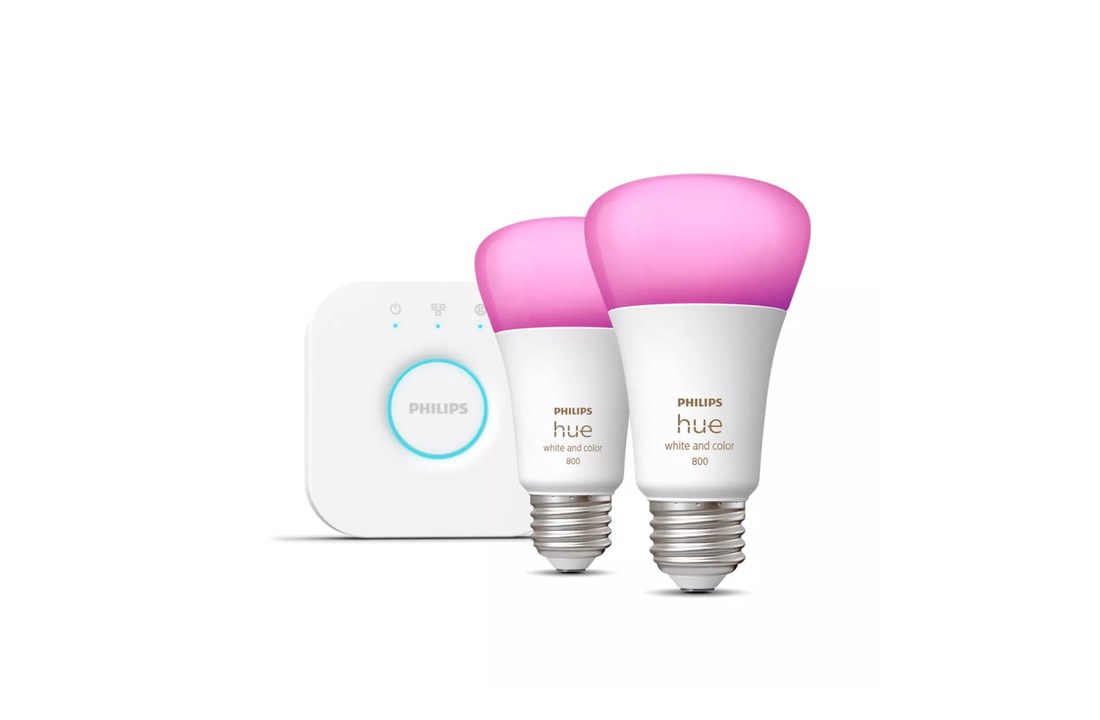
The Hue Starter Kit is the on-ramp to the Philips Hue smart-lighting system — it pairs the Hue Bridge (the hub) with a set of White and Color Ambiance smart bulbs. The bulbs screw into your normal fittings and produce any colour, any shade of white, at any brightness, controlled from an app or your voice. Hue is the most established, most reliable smart-lighting platform, and the starter kit is how you begin; everything else in the huge Hue range plugs into the same Bridge.
The Hue Bridge and why it matters
The Bridge is the reason to choose Hue over cheaper Wi-Fi bulbs. It is a small hub that plugs into your router and runs the lights on Zigbee, a dedicated low-power mesh network — so the bulbs respond instantly, stay connected reliably, and do not clog your Wi-Fi or drop offline the way direct-Wi-Fi bulbs do as you add more. In our testing the difference in reliability was stark: with the Bridge, dozens of lights just work, every time. It supports up to 50 lights, which is more than most homes need.
The bulbs, color and white
The White and Color Ambiance bulbs are the full-fat option: 16 million colours, the full range of white from warm candlelight to cool daylight, and smooth dimming to a low glow. In our testing the colour was rich and the whites genuinely useful — warm for evenings, cool-white for focus — and the dimming was flicker-free right down to near-off. Whether you want a specific accent colour, a cosy scene or bright task light, the bulbs deliver it, which is the whole appeal of colour smart lighting.
Setup
Setup is genuinely easy: plug the Bridge into your router, screw in the bulbs, open the Hue app, and it finds everything and walks you through naming rooms. From nothing to a controllable, colour-changing room takes about ten minutes. Adding more bulbs later is a matter of screwing them in and tapping to pair. It is the smoothest onboarding in smart lighting, and it is a large part of why Hue is the recommendation for people new to the category.
App, scenes and automation
The Hue app is mature and powerful without being confusing. You group bulbs into rooms, save scenes (a set of colours and brightnesses you can recall with one tap), and build routines — lights that fade on at sunset, wake you gently in the morning, or switch off when you leave. In our testing the scenes and schedules were reliable and genuinely useful day to day. The app is where Hue’s years of refinement show, turning bulbs into an actual lighting system.
Voice and smart-home integration
Hue works with everything: Amazon Alexa, Google Assistant and Apple HomeKit/Siri, so you can control lights by voice or fold them into wider smart-home automations. In our testing the integrations were fast and dependable — ‘turn the office lights to daylight’ simply worked. Because the Bridge handles the local network, voice and app commands are quick and reliable rather than laggy. It slots into whatever ecosystem your home already uses.
Expanding the system
The starter kit is a foundation, not a ceiling. The Bridge runs the entire Hue range — more bulbs, light strips, lamps, outdoor fixtures, dimmer switches and motion sensors — all on the same reliable network and app. That expandability is Hue’s long-term strength: you start with a couple of bulbs and grow the system room by room over years, and it all stays coherent. Committing to the Bridge ecosystem is what makes Hue an investment rather than a gadget.
How it compares to the alternatives
Against cheap direct-Wi-Fi bulbs (Wyze, Kasa, Govee), Hue costs more but wins decisively on reliability, response speed and how well it scales — budget bulbs are fine for one or two, frustrating for a dozen. Against other hub-based systems, Hue’s ecosystem breadth, app maturity and long-term software support keep it the benchmark. The trade is simple: pay more up front for lighting that still works flawlessly years and dozens of bulbs later.
Price, value and who it’s for
At around $199 the starter kit costs several times what off-brand bulbs do, and the value is entirely about reliability and scale: if you want a couple of novelty bulbs, cheaper options work; if you want a smart-lighting system that stays fast and dependable as you expand it across the house, Hue is worth every extra dollar. Buy it if you are serious about smart lighting and want the platform to build on. Skip it if you only want one or two bulbs and will never expand — then a cheap Wi-Fi bulb is enough.
Pros & cons
What we like
- The Bridge hub makes the system fast and rock-solid at any scale
- Rich 16-million-colour bulbs with genuinely useful tunable white
- Easiest setup and the most mature app in smart lighting
- Works with Alexa, Google and HomeKit reliably
- Huge, coherent ecosystem to expand into over years
Worth knowing
- Costs several times more than off-brand Wi-Fi bulbs
- The Bridge is another box plugged into your router
- Overkill if you only want one or two bulbs
- Full-colour bulbs are the pricier option in the range
Where to buy the Philips Hue Starter Kit
Check the current price and availability before you buy — it moves.
Check the price →FAQ
Is the Philips Hue Starter Kit worth it?
Do I need the Hue Bridge?
Philips Hue vs cheap Wi-Fi bulbs — which should I get?
How many bulbs can a Hue Bridge control?
Does Philips Hue work with Alexa and HomeKit?
Is the Philips Hue Starter Kit easy to set up?
The Finer Home may earn a commission if you buy through links on this page, at no extra cost to you. We buy and test what we review; prices were accurate at publishing — confirm at checkout. See our affiliate disclosure.