Breville Dual Boiler Review
The verdict
$1,600How we tested the Breville Dual Boiler
We ran the Dual Boiler as our daily machine for two months, pairing it with a quality grinder to test temperature stability, simultaneous brew-and-steam, milk power and the real backflush-and-descale routine.
- Pulled shots daily for 60 mornings with a separate quality grinder
- Checked brew-temperature stability shot after shot against the PID
- Steamed milk while brewing to test the dual-boiler advantage
- Followed the backflush and descale routine to judge upkeep
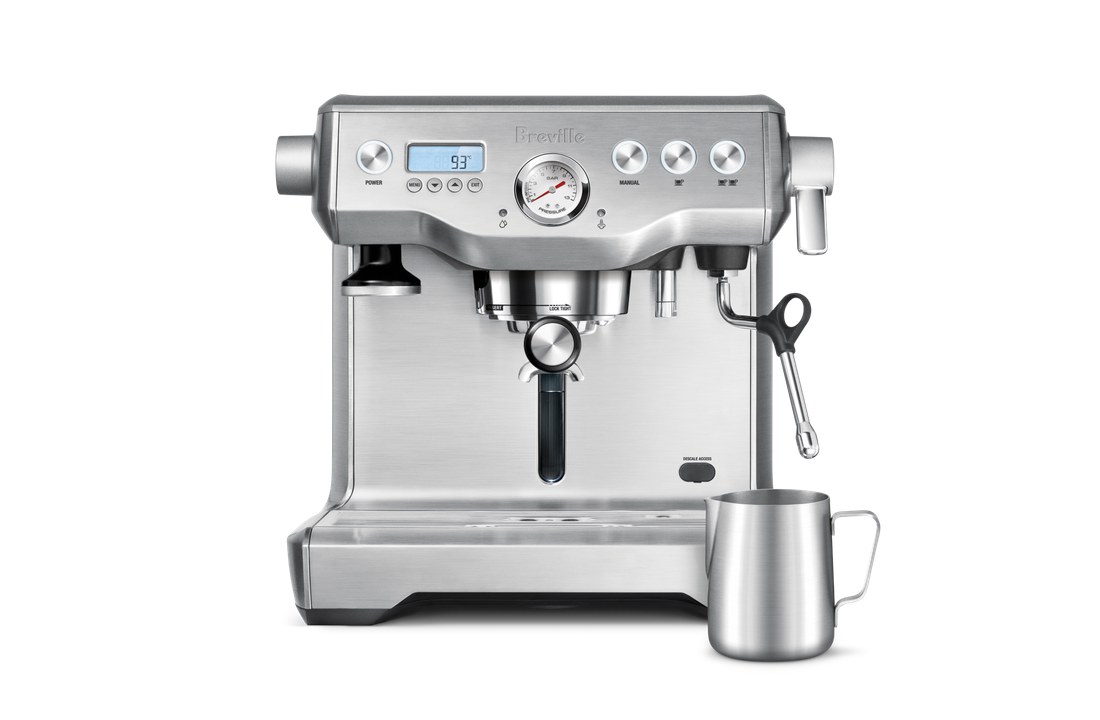
Once you have learned espresso on a single-boiler machine, one wall appears: you cannot brew and steam at the same time, and the temperature drifts. The Breville Dual Boiler removes both. Two independent, PID-controlled boilers hold brew and steam temperatures rock-steady and run at once, a 58mm commercial portafilter matches cafe gear, and a shot-timer and pressure gauge put a real workflow on your counter. At $1,600 it is the machine we point serious home baristas to when the Barista Express is no longer enough.
| Type | Dual-boiler semi-automatic |
| Portafilter | 58 mm commercial, 22 g dose |
| Boilers | 10 oz brew (700 W) + 32 oz steam (900 W), triple PID ±2°F |
| Steam temp | Adjustable 265–285°F |
| Brew + steam | Simultaneous |
| Warm-up | About 10–12 min from cold |
| Water tank | 84 oz, removable |
| Gauge | Analogue pressure gauge |
| Warranty | 2 years |
What the Breville Dual Boiler is
The Dual Boiler is a semi-automatic espresso machine built around two separate stainless boilers — one for brewing, one for steaming — each held to temperature by PID control. That is the architecture prosumer and light-commercial machines use, and it is what lets the Dual Boiler pull a shot and steam milk simultaneously without the temperature swings a single-boiler machine suffers. It pairs that with a 58mm commercial portafilter, so your technique and accessories carry straight over to a cafe.
Design and build quality
It feels like a serious machine: a brushed stainless body, a heavy 58mm portafilter that locks with authority, an analogue pressure gauge, and an 84-ounce removable tank. The controls are physical and legible — a shot-timer, temperature adjustment, and a steam lever rather than a button. It is bigger and heavier than an entry machine, and it looks the part on a counter. Nothing about the build reads as a shortcut; this is where the price starts to show.
Setting it up
First setup takes 15–20 minutes plus warm-up: fill the tank, run water through the group and wand to prime, and let the boilers come up to temperature, which takes about 10–12 minutes from cold. Breville includes both single- and dual-wall baskets, a razor dosing tool, a tamper, and a cleaning kit, so you are not buying accessories on day one. Programming shot volumes and temperature is straightforward through the front controls.
Pulling shots and temperature control
This is where the dual-boiler design pays off. In our testing the brew temperature held within a couple of degrees shot after shot — the triple-PID system keeps the group and boiler stable — so once dialled in, the machine is repeatable in a way single-boiler machines are not. The 58mm basket and 22-gram dose give cafe-sized pucks, pre-infusion is adjustable, and the pressure gauge turns dialling in into a visible task. Back-to-back shots do not drop in quality.
Steaming milk
The dedicated 32-ounce steam boiler is the other half of the upgrade. It produces strong, dry steam on demand — no waiting to switch modes — and because it is independent you can steam while a shot pulls. In our testing it whipped tight microfoam quickly and had enough power for several milk drinks in a row without recovery lag. The steam temperature is adjustable, letting you tune pressure. For a milk-drink household, this is the feature that justifies the step up.
Cleaning and maintenance
A machine this capable asks for a little discipline. Daily care is a wipe of the wand and a rinse of the basket; every week or two you backflush the group with the included blind basket and a cleaning tablet, and you descale on a schedule the machine tracks. The removable tank and drip tray make routine cleaning easy. Staying on top of backflushing and descaling is the single biggest factor in how long the boilers and valves last.
Living with it day to day
Once it is warm, the routine is fast and satisfying: grind, dose, tamp, pull, steam — all without fighting the machine. The warm-up is the daily cost; many owners put it on a smart plug or timer so it is ready by breakfast. It takes more counter space and more attention than a Barista Express, but it rewards the effort with cafe-level consistency. As a machine you use every morning for years, it settles into a genuinely enjoyable ritual.
How it compares to the alternatives
Against Breville’s own Barista Express, the Dual Boiler drops the built-in grinder but adds the second boiler, PID stability, simultaneous brew-and-steam and a 58mm portafilter — a real jump in capability and price. Against traditional prosumer machines (Rocket, Profitec) at $2,000–$3,000, it delivers most of the performance for less, trading some longevity and repairability. Against a super-automatic like the Jura, it asks for skill but rewards it with better, more controllable espresso.
Price, value and warranty
At $1,600 the Dual Boiler is a serious purchase, but it undercuts traditional prosumer machines while matching much of their capability — dual boilers and PID for the price of one heat-exchanger machine. The two-year warranty is solid for the category, and Breville’s parts availability is good. For a household that will use it daily for years and wants cafe-level results, the cost per morning is low. You do need to bring your own quality grinder.
Who it is for, and who should skip it
Buy it if you have outgrown a single-boiler machine, want simultaneous brewing and steaming, and are willing to bring a good grinder and some technique. Skip it if you want one-touch convenience — a super-automatic is the better tool — or if you are just starting out, where the Barista Express is more forgiving and includes a grinder. For the committed home barista, this is the machine that stops the upgrade itch.
Pros & cons
What we like
- Two PID-controlled boilers brew and steam at once, rock-steady
- 58mm commercial portafilter matches cafe gear and technique
- Strong, dry steam with power for back-to-back milk drinks
- Pressure gauge and shot-timer make dialling in visual and repeatable
- Prosumer capability well below traditional prosumer prices
Worth knowing
- No built-in grinder — budget for a good one
- 10–12 minute warm-up from cold
- Bigger, heavier and more demanding than an entry machine
- Needs regular backflushing and descaling to last
Where to buy the Breville Dual Boiler
Check the current price and availability before you buy — it moves.
Check the price →FAQ
Is the Breville Dual Boiler worth it over the Barista Express?
Does the Breville Dual Boiler have a grinder?
Can it brew and steam at the same time?
How long does the Breville Dual Boiler take to heat up?
How accurate is the temperature?
Is the Breville Dual Boiler hard to maintain?
The Finer Home may earn a commission if you buy through links on this page, at no extra cost to you. We buy and test what we review; prices were accurate at publishing — confirm at checkout. See our affiliate disclosure.