
The verdict
$1,004How we tested the Steelcase Leap
We sat in the Leap for full workdays over three months — testing LiveBack support, the 4D arms and lumbar adjustments, the padded feel, and long-hours comfort.
- Sat in it for full working days over three months
- Tested how LiveBack flexes and supports the spine on the move
- Dialled in the 4D arms, seat depth and lumbar firmness
- Judged the padded comfort and fatigue over long days
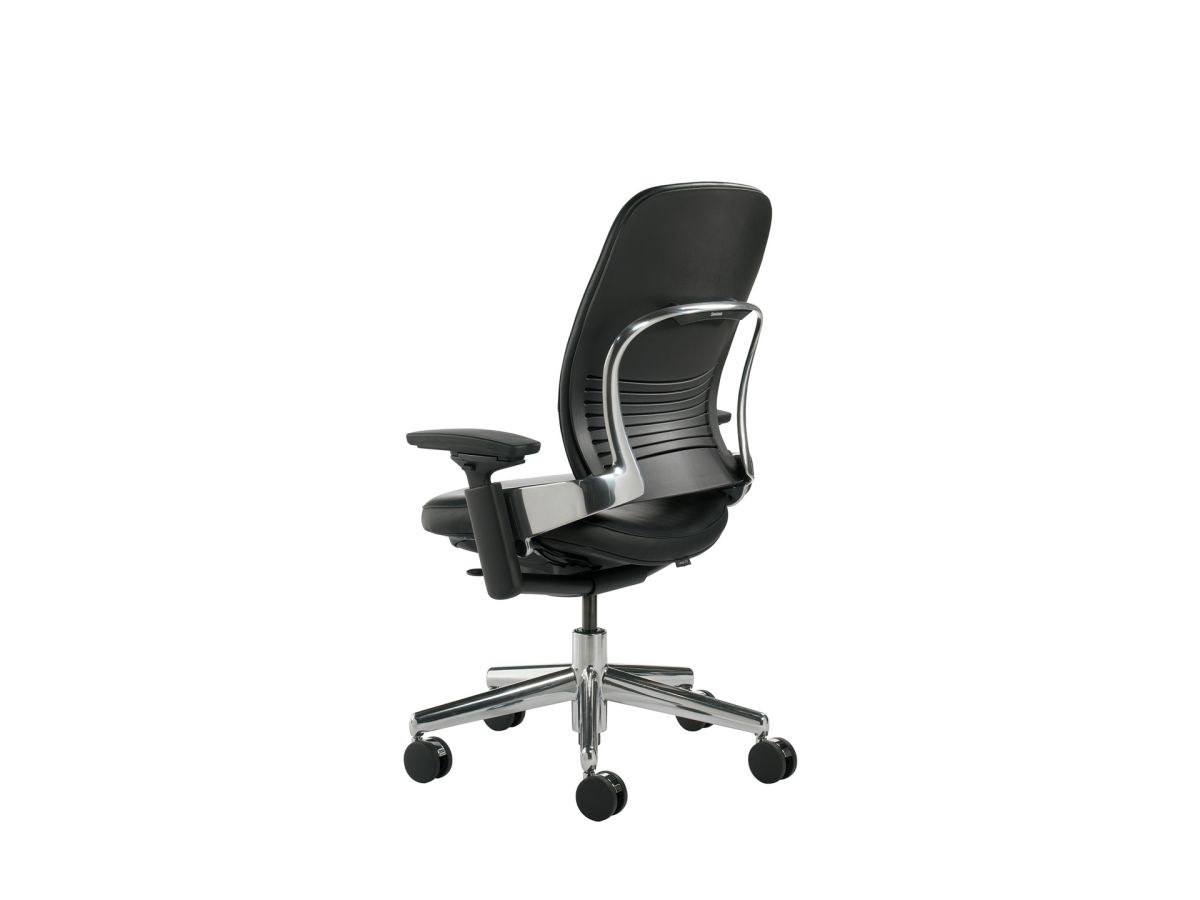
Where the Aeron fits you with sizes, the Steelcase Leap fits you with adjustments. Its LiveBack backrest flexes and changes shape as you move, mimicking the spine, and almost everything else — arm height, width, depth and pivot, lumbar height and firmness, seat depth, recline tension — adjusts to your body. It is a padded chair rather than mesh, which many people find more universally comfortable, and Steelcase backs it for life. For the sitter who wants to dial in every detail, it is the benchmark alternative.
| Type | Ergonomic padded task chair |
| Back | LiveBack — flexes to follow the spine |
| Lumbar | Height-adjustable + lower-back firmness dial |
| Arms | 4D adjustable (height, width, depth, pivot) |
| Seat | Flexible-edge, upholstered, adjustable depth |
| Recline | Adjustable tension & recline |
| Material | Metal frame, high-performance fabric |
| Warranty | Limited lifetime (12 yr, 24/7) |
| Best for | All-day sitters wanting padded support |
What the Steelcase Leap is
The Leap is Steelcase’s flagship ergonomic task chair and one of the two chairs (with the Aeron) that most ‘best office chair’ lists come down to. Its signature is LiveBack technology — a backrest engineered to flex and change shape as you move, so it supports your spine’s natural motion rather than holding you in one position. Unlike the mesh Aeron, the Leap is upholstered and padded, and it leans on deep adjustability rather than fixed sizes to fit a wide range of bodies.
Design and materials
The Leap is less of a design icon than the Aeron and more of a quiet ergonomic workhorse — a padded, upholstered chair on a sturdy metal frame, available in many fabric colours. The build feels industrial-grade and durable rather than showy. The seat has flexible edges that bend where your legs meet it to relieve pressure, and the padding gives the plush, cushioned sit that mesh-chair sceptics prefer. It looks at home in an office or a study without dominating the room.
LiveBack and back support
LiveBack is the reason to buy the Leap. In our testing the backrest genuinely moved with us — the upper and lower back flex independently, so as you recline or shift, the chair changes shape to keep contact and support across your whole spine rather than just pushing at one point. Paired with a height-adjustable lumbar and a firmness dial that sets exactly how much lower-back support you feel, it is one of the most naturally supportive backs on any chair. For back comfort through a long day, it is superb.
Adjustability and controls
The Leap’s other headline is how much adjusts. The 4D arms move up/down, in/out, forward/back and pivot, so they support your forearms in almost any posture; the seat depth slides to fit your leg length; the recline tension and range set how the chair moves with you; and the lumbar adjusts for height and firmness. In our testing this breadth meant almost anyone could dial in a genuinely custom fit — the Leap’s answer to the Aeron’s sizing is universal adjustment.
The sitting experience
Day to day, the Leap is a plush, supported, adaptable sit. The padding makes it feel softer and more immediately welcoming than the firm Aeron mesh, and LiveBack keeps you supported as you move, lean and recline through the day. In our testing it was comfortable for full working days, with the flexible seat edge easing pressure behind the knees. If your instinct is that a good chair should feel cushioned rather than taut, the Leap is the more intuitive choice.
Build quality and durability
The Leap is built like commercial furniture, because it is — a steel frame and hard-wearing components rated for round-the-clock office use. Steelcase backs it with a limited lifetime warranty (12 years, multi-shift, 24/7 parts and labour), which reflects genuine confidence in the durability. In practice these chairs last well over a decade of heavy use, and the padded surfaces wear slowly. Like the Aeron, it is a chair you buy expecting to keep for the long haul.
How it compares to the alternatives
Against the Herman Miller Aeron, the Leap trades mesh breathability and sized fit for a padded feel and universal adjustability — the classic mesh-versus-cushion, sizing-versus-adjustment debate, and both are excellent. Against Steelcase’s own Gesture, the Leap is the pure desk-work chair while the Gesture adds arms designed for phones and tablets. Against cheaper ergonomic chairs, the Leap’s LiveBack, adjustability range and lifetime warranty put it in the top tier.
Price, value and warranty
At around $1,004 the Leap is a premium chair but often undercuts a loaded Aeron, and the limited lifetime warranty makes it a genuine long-term value. For the adjustability and back support you get, plus a chair that lasts well over a decade of daily use, the cost per year is small for anyone who sits for work. Refurbished Leaps are also widely available at lower prices, which is a smart way into a top-tier ergonomic chair for less.
Who it is for, and who should skip it
Buy it if you want a padded, deeply adjustable chair whose back moves with your spine and fits your body through adjustment rather than sizing — ideal for all-day desk work and for households where several people share one chair. Skip it if you specifically want breathable mesh or the Aeron’s design (the Leap is cushioned and understated), or if you only sit occasionally. For adjustable padded support, it is the benchmark.
Pros & cons
What we like
- LiveBack flexes to follow and support your spine as you move
- Deep 4D-arm and lumbar adjustability fits almost any body
- Padded seat many find more welcoming than mesh
- Flexible seat edge eases pressure behind the knees
- Limited lifetime warranty and commercial-grade durability
Worth knowing
- Padded, not breathable — warmer than a mesh chair
- Understated design, less of a statement than the Aeron
- Premium price (though often below a loaded Aeron)
- So many adjustments there is a short setup learning curve
Where to buy the Steelcase Leap
Check the current price and availability before you buy — it moves.
Check the price →FAQ
Is the Steelcase Leap worth it?
Steelcase Leap vs Herman Miller Aeron — which is better?
What is LiveBack on the Steelcase Leap?
Is the Steelcase Leap good for back pain?
How adjustable is the Steelcase Leap?
Does the Steelcase Leap have a good warranty?
The Finer Home may earn a commission if you buy through links on this page, at no extra cost to you. We buy and test what we review; prices were accurate at publishing — confirm at checkout. See our affiliate disclosure.